![Sjunne [ dot ] com](https://sjunne.com/wp-content/uploads/2014/11/unnamed-kopia.jpg)
Did these influential thinkers only want to influence the everyday lives of their fellow human beings and get people to behave better? Or did they also want to build systematic metaphysical systems to explain everything that exists — matter, consciousness, change, and the cosmos?
For Buddhists, the point was not to get caught up in philosophical questions. Buddha told a parable to the monk Mālukyaputta:
“A man is shot with an arrow thickly smeared with poison. His friends and relatives rush to him with a doctor to pull out the arrow and save his life. But the injured man refuses and says: ‘I will not allow the arrow to be pulled out until I know: Who shot me — was he a warrior, a priest, a merchant, or a worker? What is his name, and which family does he belong to? Was he tall, of medium height, or short? Was he dark-skinned, brown-skinned, or golden-skinned? Where did he come from — from which village, town, or kingdom?’”
Buddha said that he had never promised to answer such questions. They are not relevant for ending suffering.
“You are like the man who has been shot — you are dying from the poison, that is, the suffering in life,” said Buddha, “but instead of letting me pull out the arrow through the Noble Eightfold Path, you want answers to irrelevant speculations. You will die before you get the answers.”
The learned secular Buddhist Stephen Batchelor (born 1953) has repeated this analysis in many of his works. He was first a monk in Tibetan monasteries, then in Zen monasteries in South Korea, before he married a French Zen Buddhist nun and left monastic life. They represent a pragmatic and skeptical Buddhism outside traditional belief systems.
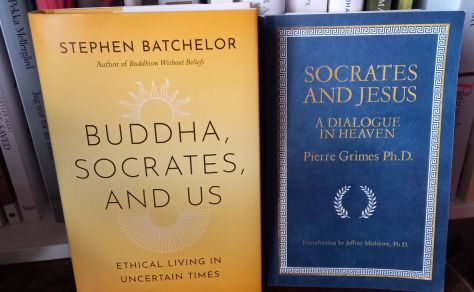
His latest book, Buddha, Socrates, and Us: Ethical Living in Uncertain Times (Yale University Press, 2025), compares these two thinkers, both of whom are interpreted as practical figures offering good advice to ordinary people.
They lived roughly at the same time — Buddha approximately 480–400 BCE and Socrates 470–399 BCE — both before the birth of Jesus. The wealthy nobleman Siddhartha Gautama renounced everything, including his wife and son, to seek the truth as a wandering ascetic.
The Greek Socrates had served in the Athenian army but left his conventional middle-class life in Athens to wander the streets and marketplaces, asking uncomfortable questions of other Greeks, especially those who considered themselves knowledgeable. He did not support his family in the usual way because he refused payment for his teaching and lived extremely simply.
The city of Athens sentenced him to death for corrupting the youth and for introducing new gods — something he denied, but he accepted the verdict and took his own life.
His disciples Plato and Xenophon wrote down his dialogues. Plato’s later texts show an ideal world in which the essence of something — for example, a circle — can be said to exist in eternal forms/ideas. Xenophon sticks to Socrates’ practical advice on how one should behave.
Socrates himself turned against the Greek natural philosophers who sought answers to what everything consisted of — fire, water, air — and instead concentrated on questions about how one should live and developed methods of conversation to arrive at truth. The French historian of philosophy Pierre Hadot has revived this notion of philosophy as a way of life.
Just as Plato gave a metaphysical interpretation of Socrates, the Buddhist Nagarjuna in the 2nd century interpreted Buddha’s thoughts as saying that the world essentially consists of emptiness, śūnyatā. Despite his skepticism toward metaphysics, Stephen Batchelor has translated Nagarjuna’s central work Mūlamadhyamakakārikā.
The third thinker, possibly also misinterpreted, Jesus of Nazareth, has likewise received philosophical interpreters even though he mostly spoke about morality and love for his fellow human beings. With support from Plato and his student Aristotle, the Orthodox and Catholic churches have built systematic theologies to explain the universe and Jesus’ place in it, based on Augustine and Aquinas.
The independent philosophical therapist Pierre Grimes (1924–2024) built further on Batchelor’s comparison and published the book Socrates and Jesus: A Dialogue in Heaven (Opening Mind Press, 2023).
Both Socrates and Jesus died as martyrs for their ideas. In Grimes’ heaven, they continue to discuss what they actually wanted to say but which their followers did not understand. For example, the concept of Logos that the evangelist John spoke of, influenced by Neoplatonism.
Grimes was a colorful outsider. He associated early on with the spiritual pioneers Alan Watts and Joseph Campbell, experimented a few times with LSD in the 1950s, and later founded Philosophical Midwifery — a therapy based on the Socratic art of midwifery in the dialogue Theaetetus — after he had taken care of alcoholic, down-and-out men after 1945.
Batchelor and Grimes are examples of freethinkers, just like their role models Buddha, Socrates, and Jesus, whom we should welcome into philosophy and religion — preferably together.
Jan Sjunnesson, MA in Philosophy and independent writer
 Sjunne [ dot ] com